
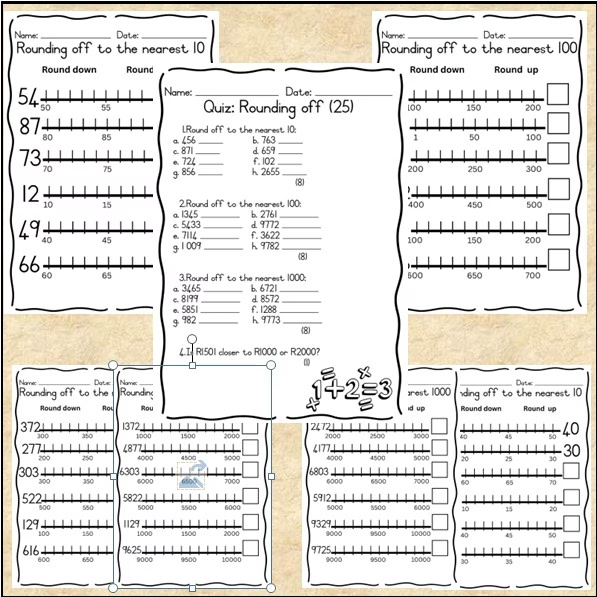
Description
Rounding-off posters and activities are important because they simplify a complex math skill into clear, visual, and interactive formats that help learners grasp the concept quickly, apply it in real-life situations, and build confidence in estimation and number sense. They make abstract rules concrete, memorable, and engaging for students.
🎯 Why Rounding Posters Matter
- Visual reinforcement: Posters display rules and rhymes (e.g., “5 or more, raise the score”) that learners can reference at any time, reducing confusion.
- Consistency: They provide a standard classroom anchor, ensuring all students follow the same method.
- Memory aid: Catchy rhymes and visuals help students recall rounding rules without rote memorization.
- Accessibility: Learners who struggle with abstract math benefit from concrete, colorful cues.
🧩 Importance of Rounding Activities
- Hands-on practice: Activities like games, worksheets, and number line exercises allow learners to apply rounding in different contexts.
- Engagement: Interactive tasks (sorting numbers, rounding races, estimation challenges) turn a potentially dry skill into something fun.
- Real-life application: Activities connect rounding to everyday scenarios—shopping, weather forecasts, distances—showing students why the skill matters.
- Differentiation: Teachers can adapt activities for varying levels, from basic rounding to tens/hundreds to decimals.
📊 Comparison: Posters vs. Activities
| Feature | Posters (Static Visuals) | Activities (Interactive Practice) |
|---|---|---|
| Purpose | Reinforce rules visually | Apply rules through practice |
| Engagement | Passive reference tool | Active participation |
| Retention | Supports memory via rhymes | Builds deeper understanding via repetition |
| Classroom Use | Displayed as constant aid | Used in lessons, group work, or homework |
| Best For | Quick reminders, visual learners | Skill mastery, kinesthetic learners |
🌍 Why It’s Crucial in Education
- Builds number sense: Rounding helps learners estimate and understand magnitude, a foundational math skill.
- Supports problem-solving: Simplifies calculations, especially in mental math.
- Prepares for higher math: Essential for statistics, measurement, and real-world problem-solving.
- Life skill: Learners use rounding daily—budgeting, reading data, interpreting measurements.
⚠️ Key Considerations
- Avoid rote tricks only: Posters and rhymes are helpful, but students must also understand why rounding works.
- Balance visuals with practice: Over-reliance on posters without activities can lead to shallow learning.
- Context matters: Activities should connect rounding to meaningful, everyday examples to make the skill relevant.
✅ In short, posters anchor the rules, while activities bring them to life. Together, they ensure learners not only remember how to round but also understand when and why to use it.