
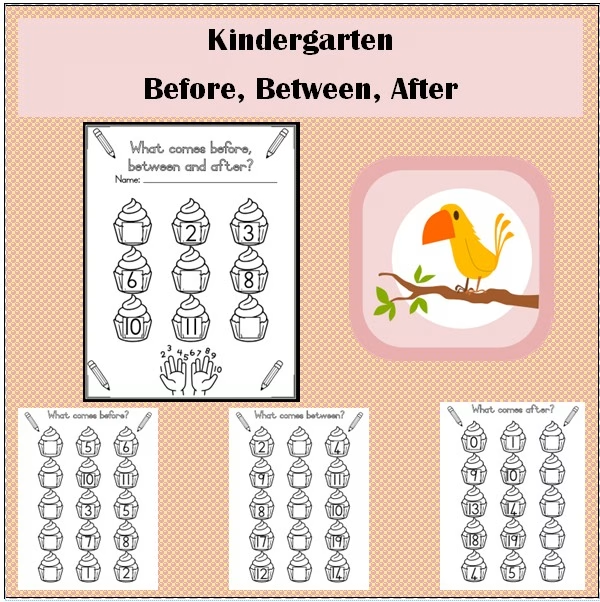
Description
The best way to teach “before, between, and after” is through hands-on activities, visual cues, and playful repetition. Use toys, number lines, and storytelling to make the concept concrete and fun.
What do you get? Complete activity booklet A4 and A5, 2 classroom posters.
🧠 Why It Matters
Understanding “before, between, and after” builds number sense, which is foundational for Mathematical fluency, sequencing, and problem-solving. It also strengthens spatial reasoning and prepares learners for place value and patterns.
🧸 Engaging Teaching Ideas
1. Number Line Adventures
- Use a large floor number line or draw one on a poster.
- Have learners “walk” to a number and ask:
- “What number comes before?”
- “What number comes after?”
- “Stand between 4 and 6—what number are you?”
2. Toy Train Game
- Line up 3–5 toy animals or blocks with numbers.
- Ask: “Who is sitting before number 3?” “Who is between 2 and 4?”
- Let learners rearrange and explain their choices.
3. Story-Based Learning
- Create short stories: “Lulu the Leopard stood between Benny the Frog (number 2) and Tilly the Turtle (number 4). What number is Lulu?”
- Use character-driven visuals to reinforce positions.
4. Interactive Worksheets
- Use fill-in-the-blank sheets:
- “___ comes before 7.”
- “___ is between 5 and 7.”
- “___ comes after 9.”
- EDUGIZELLE offers printable resources.
5. Real-Life Objects
- Use fruit, crayons, or shoes. Line them up and number them.
- Ask learners to pick the item that’s “between” two others or “after” a certain one.
🎯 Tips for Success
- Use repetition with variation: Keep the structure familiar but change the numbers or objects.
- Praise reasoning: Ask learners to explain their answers—this builds confidence and deeper understanding.
- Visuals matter: Use colour-coded numbers, mascots, or themed décor (like ladybirds or leopards!) to make it memorable.