
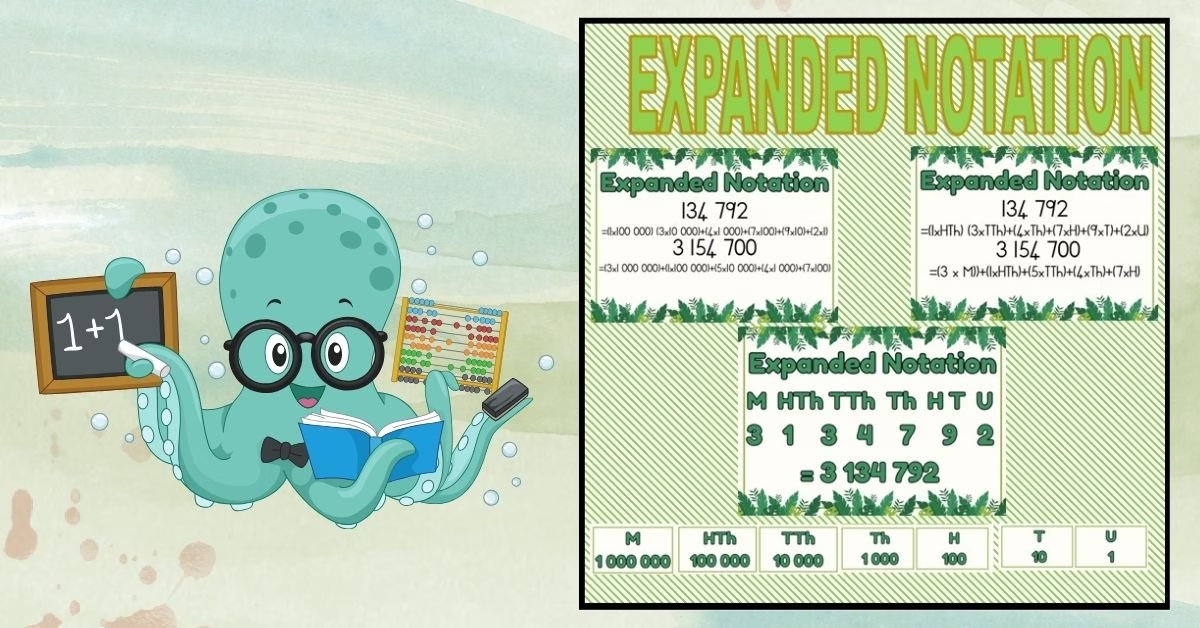
Children need to learn about expanded notation because it builds deep number sense and lays the foundation for confident, flexible mathematical thinking. Here’s why it’s so valuable in the classroom:
🔢 1. Reveals Place Value Structure
- Expanded notation breaks numbers into their place value components (e.g., 345 = 300 + 40 + 5), helping learners understand how digits represent different magnitudes.
- It’s not just about writing numbers differently—it’s about seeing how numbers are built.
🧠 2. Strengthens Mental Math Skills
- When children grasp how numbers are composed, they can mentally add, subtract, and estimate more easily.
- For example, solving 345 + 120 becomes simpler when they think:
(300 + 40 + 5) + (100 + 20 + 0)
🧮 3. Prepares for Algebra and Advanced Math
- Expanded notation introduces the idea of expressing numbers as sums of terms—an early step toward algebraic thinking.
- It also supports understanding of decimals, exponents, and scientific notation later on.
🎯 4. Promotes Flexibility and Confidence
- Learners who understand expanded notation can approach problems in multiple ways, not just by memorizing procedures.
- It encourages mathematical reasoning and adaptability—key traits for lifelong numeracy.
🧰 5. Supports Differentiation and Scaffolding
- Teachers can use expanded notation to differentiate instruction, helping struggling learners visualize numbers while challenging advanced learners to explore patterns and properties.
🧩 6. Connects to Real-World Math
- Expanded notation helps children interpret prices, measurements, and data more accurately.
- It’s especially useful when working with money, time, and large numbers in everyday contexts.